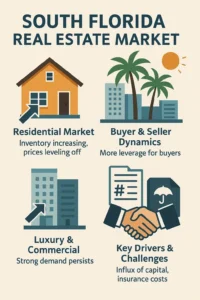
1. Residential Market: Cooling, But Not Crashing
- Inventory is rising across single‑family homes and condos: statewide inventory rose by ~28.8% compared to May 2024, reaching balanced supply levels (around 6 months for single‑family, and over 10 months for condos/townhomes) (brgintl.com, floridarealtors.org).
- Prices are plateauing or slightly declining:
- April statewide single‑family home median prices dipped ~4% year‑over‑year; Florida’s median home value is now approximately $386,556, down ~3.8% over the past year (zillow.com).
- Condo/townhome values began trending downward in mid‑2024, and most metros are now showing year‑over‑year declines (floridarealtors.org).
- Affordability pressure continues due to:
- Persistently high mortgage rates (~7%),
- Escalating insurance and HOA fees, as a result of stricter post‑Surfside regulations and pending reserve requirements (marketwatch.com, kiplinger.com, the-sun.com).
2. Buyer & Seller Dynamics: More Leverage for Buyers
- Buyer leverage is increasing: A shrinking share of homes are selling above list price (~10.8%, down ~1 point year over year), while about one-third of listings now see price reductions (redfin.com).
- Sellers are adapting: Price cuts, closing-cost contributions, and flexible terms are now more common—mirroring a nationwide cooling trend .
3. Luxury & Commercial: A Stronger Story
- Luxury condos and mixed-use developments remain in demand, especially in West Palm Beach and affluent pockets of Miami‑Dade—driven by relocations of financial and tech executives (linkedin.com).
- Commercial real estate is booming:
- Record‑low retail vacancy in key markets; premium brands are expanding into newly vibrant mixed‑use communities (nypost.com).
- West Palm Beach is emerging as Florida’s “Wall Street South,” while Miami’s office sector is stabilizing with a slowdown in new builds (linkedin.com).
4. Key Drivers & Challenges
- Influx of out‑of‑state capital: Wealthy New Yorkers and companies are relocating to Florida—bringing in demand for high-end housing, office space, and retail .
- Insurance subsidies vs. risk:
- Homeowners face mounting insurance costs, with Florida leading nationally in premiums—tripling the U.S. average in 2023 (~$6,000/year) (thetimes.co.uk).
- New laws effective July 1 2025 aim to ease condo associations’ financial burdens through funding flexibility (the-sun.com).
- Climate risk and buyer sentiment: Rising sea levels, frequent flood events, and insurers retreating from vulnerable zones are creating “climate risk drag” on certain property types (thetimes.co.uk).
🧠 What This Means for Stakeholders
For Buyers For Sellers/Investors For Realtors Increased negotiation power—use leverage on price, terms, or contingencies. Expect slower sales and longer days on market; be strategic with pricing and incentives. Educate clients on market balance, financing challenges, insurance impacts. Prioritize newer, lower-insurance-risk properties and flood-resilient areas. Luxury and commercial offerings in the right locations remain strong bets. Focus marketing on condo alternatives and mixed-use project value. Consider longer-term gains as equity levels remain ~50% above 2020 prices. Finance structures like rental conversions or mixed-use conversions may perform well. Embrace local legislation updates (e.g., July 1 condo reforms) to advise clients.
🔑 Strategic Insights & SEO Hooks
- #SouthFloridaHousing – highlight increasing inventory and buyer concessions.
- #LuxuryCondoBoom – spotlight Miami‑Dade & West Palm wealth influx and development.
- #InsuranceChallenges – dissect condo‑law effects & rising premium trends.
- #ClimateRisk – evaluate resilient property opportunities as flood-prone areas lag.
- #CommercialRealEstate – feature hot retail/office trends in mixed-use zones.
✅ Final Take
The South Florida real estate market in mid‑2025 is shifting from pandemic-fueled escalation into measured equilibrium:
- Overall home prices are stabilizing or cooling, with inventory giving buyers the upper hand.
- Luxury and commercial sectors remain resilient, supported by high‑income relocations and investment.
- Rising costs—insurance, HOA, climate risk—pose affordability constraints and require savvy strategies.
For sellers and investors, the key is smart pricing, location selection, and leveraging incentives. For buyers, it’s a rare window of opportunity—but diligence is essential: analyze insurance, flood risk, and long-term equity potential.
Curious about hyper-local trends in Miami vs. Broward? Want to dive deeper into the condo‑law changes effective July 2025? Just say the word.